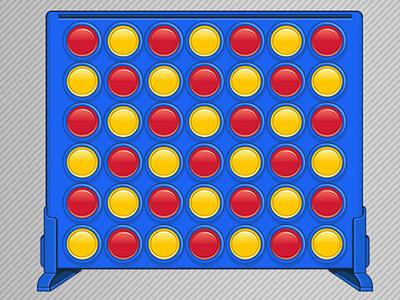
Connect 4 Strategy: How to Win Almost Every Game
Connect 4 looks like a children's game, and it is one, but it also has real depth. The game was solved by computer in 1988, which means we know that the first player can always force a win with perfect play. You do not need perfect play to beat most people, though. A few simple ideas will take you a long way.
The rules in brief
The grid has seven columns and six rows. Players drop discs in turn, and each disc falls to the lowest empty space in its column. The first to make four in a row wins, whether horizontally, vertically or diagonally.
1. Play the centre
The centre column is part of more possible lines of four than any other. The bottom-centre space belongs to seven possible lines of four, while a bottom corner belongs to only three. If you go first, start in the centre. If you go second and it is open, take it as soon as you can.
2. Check the space above
This is the single most common mistake. Every disc you play makes the space above it available. Before you drop a disc, ask what your opponent can do with the next space. Many games are lost by a move that looks harmless but gives away the winning spot directly above.
3. Make two threats at once
A threat is any line of three with an open fourth space. One threat can simply be blocked. Two threats at once cannot, so most games between decent players are won this way. Look for a disc that adds to both a horizontal and a diagonal line at the same time.
4. Stack your threats
Two winning spaces directly on top of each other are very strong. If your opponent blocks the lower one, you play the space above it and win. If you can set up this pattern, the game is effectively over.
5. Learn the odd and even rule
In a close game, the board fills up until someone is forced to play under the other player's winning space. This is called zugzwang, and it follows a pattern. Number the rows 1 to 6 from the bottom.
- The first player wants threats on odd rows (1, 3, 5).
- The second player wants threats on even rows (2, 4, 6).
Why does this work? If the rest of the board fills up evenly, turn order means that each player ends up taking those rows in the columns that remain. If you are first, an odd-row threat will usually come to you. If you are second and your opponent has no odd-row threat, an even-row threat wins by the same logic.
6. Deny, then build
Every turn, look at the board in this order:
- Can I win right now?
- Does my opponent have a win I must block?
- Will my move let them win on the space above?
- Can I make a double threat?
- Otherwise, which move adds the most to my own lines?
Following this routine will stop nearly all of your careless losses.
Common mistakes
- Vertical stacking. Three in a column is easy to see and takes one disc to block.
- Playing only on the edges. Discs at the side connect to very little.
- Only reacting. If every move is a block, you have already given up control of the game.